


Who Is Venezuela’s New President? The Rise of Delcy Rodríguez Amid an Unprecedented Crisis
From a Marxist legacy to the highest office of the state, as Venezuela enters a critical transition under intense U.S. scrutiny.
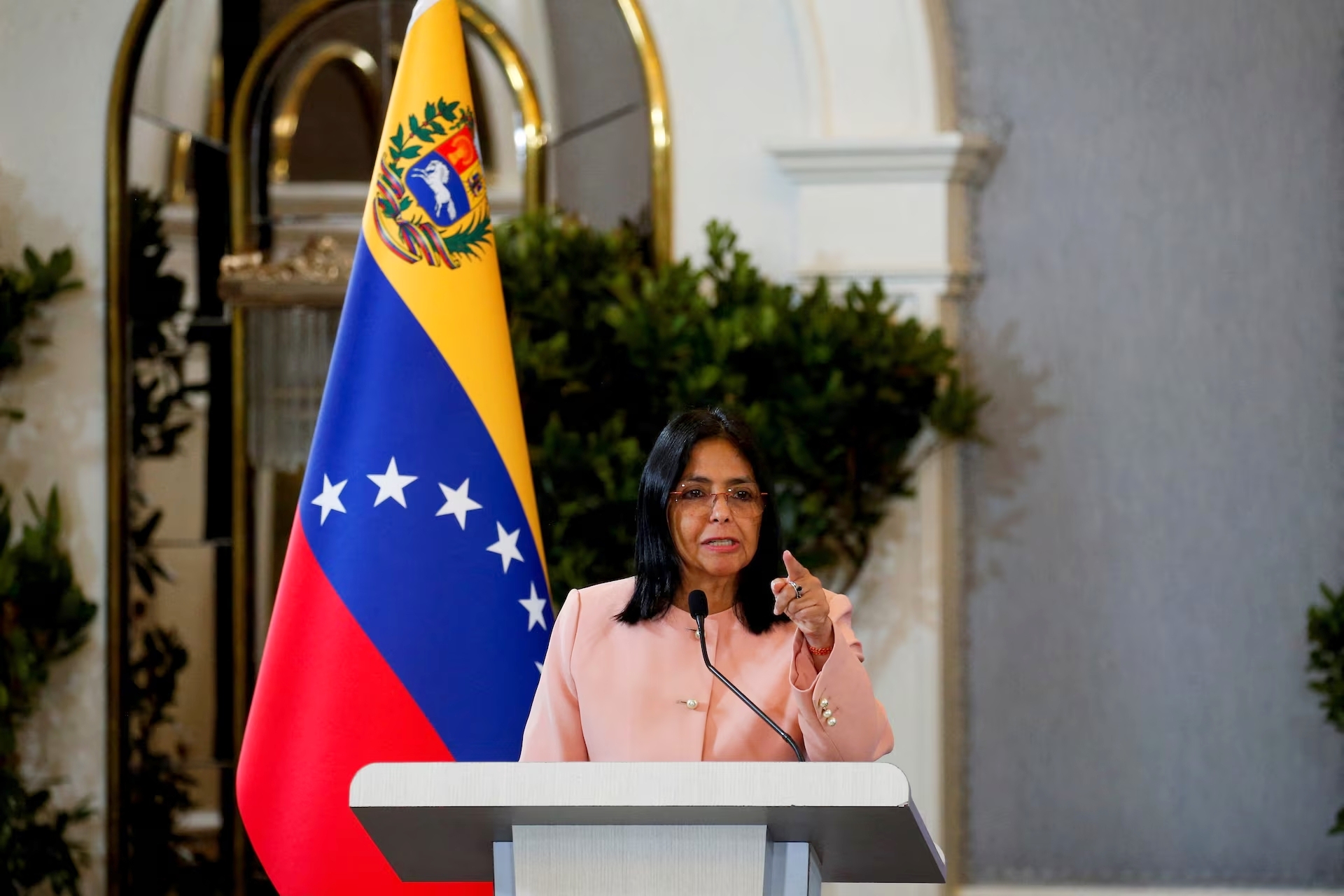
The ascent of Delcy Eloína Rodríguez Gómez to Venezuela's presidency comes at one of the most extraordinary and fragile moments in the country's modern history. Her assumption of power did not follow an electoral process or a conventional constitutional transition, but instead occurred after the capture of President Nicolás Maduro by U.S. forces on January 3, 2026.
At 56 years old, Rodríguez takes control of the Venezuelan state amid deep political uncertainty, international pressure, economic collapse, and social exhaustion, while every move she makes is closely watched by the administration of U.S. President Donald Trump, which has made clear that it expects compliance with its strategic objectives.
An Extraordinary Succession Under International Scrutiny
Rodríguez's swearing-in took place under circumstances with no clear constitutional precedent. While formally installed as president, she has repeatedly insisted that Maduro remains Venezuela's "legitimate president", a position that reflects the internal contradiction now facing the ruling movement: ideological continuity versus the new geopolitical reality.
In her first public statements, Rodríguez condemned the U.S. military operation as a "brutal attack", described Maduro's removal as a "kidnapping", and demanded that Washington provide "proof of life" for the detained leader. This rhetoric aligns with the long-standing chavista narrative of foreign aggression and violated sovereignty.
Yet behind the defiant language lies a political reality that severely constrains her options: Venezuela's immediate future is deeply entangled with U.S. decisions, including sanctions enforcement, diplomatic recognition, and access to international markets.
Trump's Warning: A Personal Line in the Sand
President Trump moved quickly to establish red lines. Speaking to The Atlantic, he issued a direct and personal warning to Rodríguez:
"If she doesn't do what's right, she is going to pay a very big price — probably bigger than Maduro."
The statement was widely interpreted as a deterrent aimed at the individual leader, signaling that Washington now views Rodríguez as fully accountable for Venezuela's next steps.
Unlike Maduro — whose relationship with the U.S. had deteriorated beyond repair — Rodríguez is treated as a figure still under evaluation, neither fully rejected nor embraced.
Washington's View: Less Ideology, More Leverage
The tone from the U.S. State Department has been notably more measured. Secretary of State Marco Rubio suggested that Venezuela's new leadership could prove more cooperative than its predecessor.
"We expect to see more compliance and cooperation than we were previously receiving," Rubio said on NBC's Meet the Press on January 4. "With Nicolás Maduro, you could not make a deal or an arrangement."
Rubio also clarified Trump's earlier remarks about "running" Venezuela:
"It's not running the country. It's running policy. We want Venezuela to move in a certain direction — not only because it's good for the Venezuelan people, but because it's in our national interest."
The message was clear: Washington seeks policy alignment rather than formal occupation, particularly on issues such as narcotics trafficking, energy, migration, and regional security.
Ideological Origins: A Legacy Forged in Political Violence
To understand Delcy Rodríguez's worldview, one must examine her family history. Her father, Jorge Rodríguez Sr., was a prominent Marxist militant and secretary general of the Socialist League, active during the turbulent decades following Venezuela's return to democracy in 1958.
Rodríguez Sr. participated in a failed leftist guerrilla movement and was detained in the mid-1970s in connection with the kidnapping of U.S. businessman William Niehous. He died while in government custody during the democratically elected administration of Carlos Andrés Pérez, after intelligence officials ordered his beating, according to a CIA document.
That episode became a formative trauma for the Rodríguez family and later a symbolic grievance embraced by chavismo against Venezuela's pre-Chávez democratic system.
From Academia to the Bolivarian Project
Delcy Rodríguez was a university law professor when then–army officer Hugo Chávez launched his failed coup attempt in 1992 against President Pérez. Chávez's eventual election in 1998 radically reshaped Venezuela's political landscape.
Rodríguez and her brother, Jorge Rodríguez, aligned themselves closely with Chávez's Bolivarian Revolution, as former guerrillas and radical leftists were gradually absorbed into positions of power.
A Steady Rise Within the Chavista State
Rodríguez's political ascent followed a deliberate and strategic path. She first served as communications minister, later as foreign minister, where she became a fierce defender of Venezuela against international sanctions, and eventually as vice president, placing her at the center of executive power.
Crucially, unlike Maduro, she does not face U.S. criminal indictments for drug trafficking, making her a less legally toxic figure for Washington. Nevertheless, she has been listed for over a decade on U.S. Treasury sanctions, dating back to the Obama administration, for alleged anti-democratic actions, serious human rights abuses, and corruption, according to the Congressional Research Service.
Ideological Continuity, Tactical Pragmatism
Publicly, Rodríguez has pledged full continuity with Maduro's policies, declaring that Venezuela will "never again be a colony." Yet diplomats and analysts note her more disciplined, technocratic, and controlled style, which may leave room for tactical negotiation.
This creates a central dilemma:
-
Will Rodríguez act as a guardian of hardline chavismo, or will she become a transitional figure, making limited concessions to preserve power and stability?
Her rhetoric suggests ideological rigidity, but her room for maneuver is shaped by external pressure more than internal consensus.
Power Under Extreme Strain
Rodríguez assumes the presidency of a country economically devastated, with institutions weakened, millions living abroad, and sovereignty openly challenged by foreign intervention.
She faces simultaneous pressure from:
-
Washington,
-
the international community,
-
the armed forces, and
-
a war-weary population.
Whether she can consolidate authority without deepening Venezuela's isolation — or whether her presidency becomes a short-lived transitional phase — remains an open question.
A Presidency With an Uncertain Horizon
Delcy Rodríguez now stands at the center of a historic inflection point. Her leadership may determine whether Venezuela enters a period of managed transition, prolonged instability, or renewed confrontation with the world's most powerful actors.